The stack effect (also called the “chimney effect”) is a natural phenomenon where warm air rises and cold air sinks, creating air pressure differences that drive air movement through your home.
In winter, this effect can dramatically increase your energy bills and make your home uncomfortable.
The Basic Physics:
- Warm air is lighter than cold air, so it naturally rises
- As warm air rises to upper floors and attic, it creates negative pressure (suction) at lower levels
- This negative pressure pulls cold air in through any gaps, cracks, or openings in the lower part of your home
- The warm air escapes through upper-level leaks (attic, upper walls, roof)
- The cycle continuously repeats, creating constant air exchange
Think of your home like a chimney:
- Heat source at bottom (your furnace)
- Warm air rises through the “chimney” (your home)
- Escapes at the top (attic, upper floors)
- Cold air gets sucked in at the bottom (basement, crawl space, first floor)
Where the Stack Effect Pulls Cold Air INTO Your Home in Winter
Bottom of House (Negative Pressure Zone):
- Crawl spaces – Cold, musty air gets sucked up through floor gaps
- Basement – Cold air infiltrates through foundation cracks and rim joists
- First floor – Cold air enters through:
- Door and window gaps
- Electrical outlets on exterior walls
- Plumbing penetrations
- Foundation cracks
- Garage connections
Result: Your heating system has to work overtime to heat the constant stream of cold air entering from below.
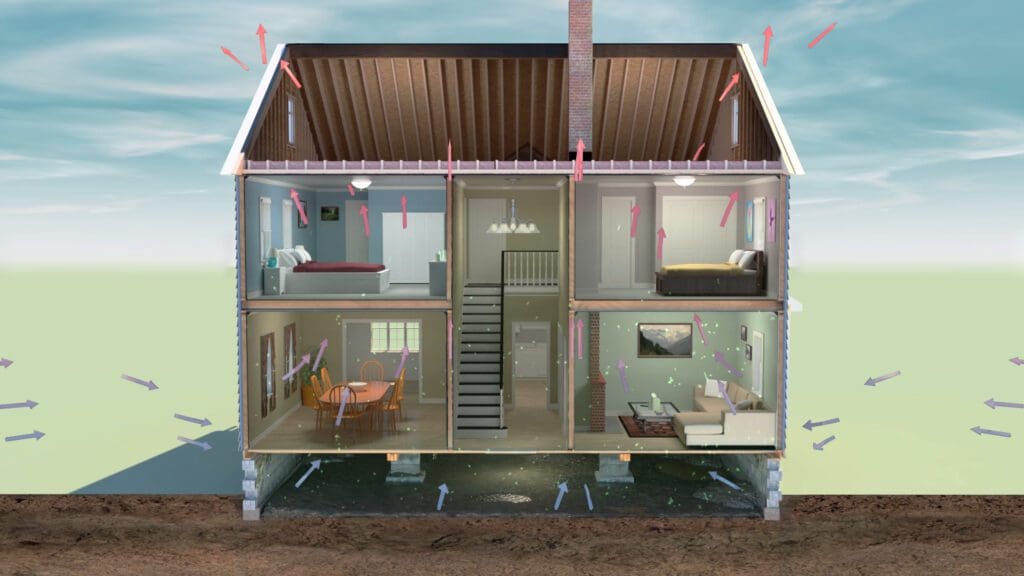
Where Warm Air ESCAPES in Winter (Stack Effect Exits)
Top of House (Positive Pressure Zone):
- Attic – Warm air escapes through:
- Attic access hatches
- Recessed lighting fixtures
- Plumbing and electrical penetrations
- Gaps around chimneys
- Inadequate attic insulation
- Upper floors – Air leaks through:
- Upper-level windows and doors
- Wall-to-ceiling connections
- Exhaust fans
- Roof penetrations
Result: You’re literally heating the outdoors while cold air replaces it from below.
How the Stack Effect Affects Your Home in Winter
1. Higher Energy Bills
- Your furnace runs constantly to replace warm air that’s escaping
- Cold air infiltration requires even more heating
- Can increase heating costs by 20-40%
- You’re essentially “heating the neighborhood”
2. Uncomfortable Living Spaces
- Cold floors (especially over crawl spaces and basements)
- Drafty rooms on lower floors
- Uneven temperatures – upstairs hot, downstairs cold
- Cold spots near windows, doors, and exterior walls
- Difficult to maintain consistent comfort
3. Poor Indoor Air Quality
The stack effect doesn’t just pull in cold air—it pulls in:
- Crawl space air (musty, moldy, contaminated)
- Basement air (damp, stale)
- Garage fumes (carbon monoxide, chemicals)
- Outdoor pollutants and allergens
- Soil gases including radon
Research shows: Up to 50% of the air on your first floor comes from your crawl space or basement due to the stack effect.
4. Moisture and Mold Issues
- Warm, moist indoor air rises to attic
- Contacts cold surfaces and condenses
- Creates moisture problems in attic
- Can lead to mold growth and wood rot
- Ice dams form on roof edges

5. HVAC System Overwork
- Furnace cycles constantly
- Reduced equipment lifespan
- More frequent repairs needed
- Higher maintenance costs
Why the Stack Effect is Stronger in Winter
The stack effect intensifies when:
- Greater temperature difference between inside and outside (winter has the biggest delta)
- Taller buildings (two-story homes have stronger effect than single-story)
- More air leaks in upper and lower areas of home
In winter:
- Temperature difference might be 50-70°F (70°F inside, 20°F outside)
- This creates strong pressure differences
- Air movement accelerates
- Energy loss increases dramatically
- Furnace thinks house needs heat (because warm air keeps escaping)
- Runs constantly to maintain 70°F
- You’re paying to heat air that immediately leaves the house
- Cold air replacement requires even more heating
Cost: This cycle can add $50-$200+ per month to winter heating bills. Yikes!!
